
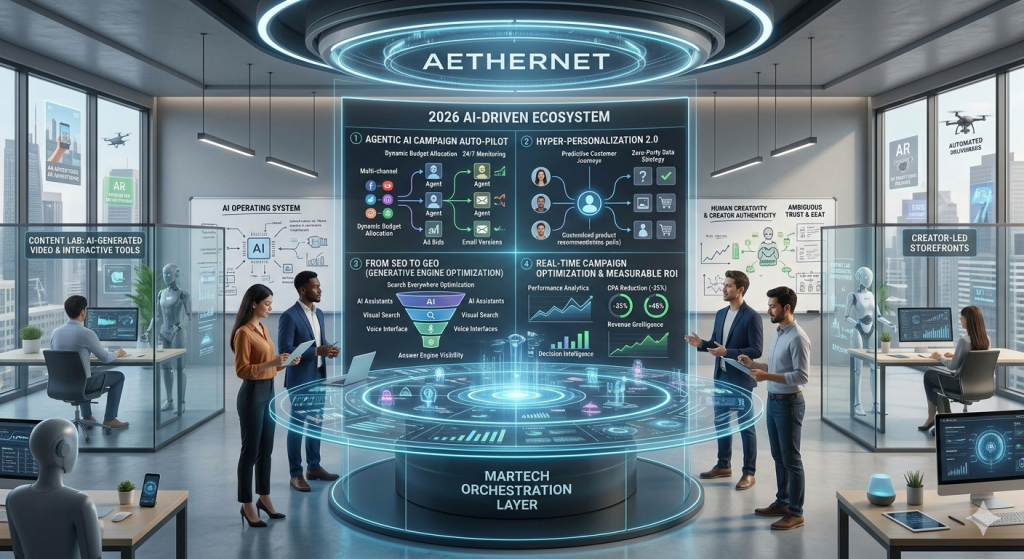
AI isn’t just “helping” digital marketing in 2026, it’s becoming the operating system behind it.
The biggest change here is that marketing has gone from manual campaign creation, to AI-driven decision making. Instead of marketers building every ad, email, audience, and workflow themselves, AI systems now create, test, optimize, and personalize in real time, all the time.
That looks like:
- Hyper-personalization at scale
Brands are using AI to personalize websites, ads, emails, product recommendations, and even pricing to every user in real time. Modern AI models take a lot of context into account, including device, intent, location, browsing patterns, sentiment, and purchase probability, not just demographic segments.
A retail website in 2026 might show:
different homepage copy to different visitors,
AI-generated product bundles,
dynamic ad creatives,
personalized checkout incentives,
and chatbot conversations that adapt to the customer’s tone.
The payoff is higher engagement and conversion rates, but it also raises concerns about “creepy” over-personalization.
- Agentic AI is replacing parts of the marketing team
“Agentic AI” — autonomous AI agents that can perform multi-step marketing tasks with little human oversight — is one of the most characteristic trends of 2026.
Rather than a marketer manually:
building audiences,
launching campaigns,
shifting spend,
analyzing results,
and rewriting copy,
AI agents can automate much of the loop.
Some are already deploying AI “marketing coworkers” that:
create ad variations,
track performance,
pause low-performing ads,
reallocate spend,
and generate reporting summaries.
The human role is increasingly more focused on strategy, brand judgment, oversight, and guidance of the creative creative direction.
- SEO is becoming GEO and AI discovery
Search behavior is shifting dramatically because people are increasingly reaching out to assistants instead of typing search terms into Google.
That has led to:
GEO (Generative Engine Optimization),
AEO (Answer Engine Optimization),
and “Search Everywhere Optimization.”
Brands are not only optimizing content for search rankings, but to appear inside AI-generated answers and recommendations.
In practice, marketers are bolstering content with:
structured data,
authoritative voice,
conversational phrasing,
expertise and authority,
and machine-readable product data.
The old “10 blue links” model is eroding. AI intermediaries increasingly determine what brands users even see.
- AI-generated content is now the norm , and not worth much on its own
2023–2024 was exciting for AI-generated content. 2026 is now the new normal, with instant content for everyone.
That means volume alone doesn’t win.
The new advantage is what some commentators call the “human premium”: real expertise, founder voice, distinct perspective, and trusted brand.
AI does first drafts,
social captions,
ad copy,
video scripts,
translations,
creative testing.
But audiences are increasingly resonating with:
humans,
distinctive voices,
honest storytelling,
trusted brands.
Consequently, AI saturation is increasing the commercial value of human authenticity.
- Privacy is becoming a differentiator
Because AI systems are feeding on more behavioral data, privacy concerns are rising fast. Consumers increasingly question brands’ data collection and use.
Marketers are talking about:
first-party data,
consent-based personalization,
contextual targeting,
clear AI policies.
That’s partly regulatory compliance, but also brand positioning. Some brands are treating privacy as a premium, rather than a compliance checkbox.
- AI is making advertising more predictive
AI systems are increasingly predicting customers’ actions before they make them.
Predictive analytics tell us chances of a customer:
churning,
buying,
reaching,
lifetime value,
when to make an offer,
campaign ROI.
Instead of reacting to campaign outcomes after the fact, marketers are moving toward proactivity.
So budgeting shifts too: media spend is increasingly algorithmically controlled.
- Marketing jobs are changing, but not going away
The industry is realigning for AI fluency. Routine production work is shrinking:
copywriting basics,
repetitive design,
simple reporting,
low-level campaign management.
Yet demand is growing for marketers who can:
manage AI systems,
read data,
build strategy,
maintain brand trust,
mix technical literacy with creative thinking.
Some companies are even looking for “marketing engineers”, 2-in-1 professionals who know automation, prompts, analytics, storytelling.
The Big Picture
Digital marketing in 2026 is becoming:
- more automated,
- more personalized,
- more predictive,
- and more AI-mediated.
But the companies winning long-term aren’t necessarily the ones using the most AI. They’re the ones combining AI efficiency with:
- trust,
- strong brand identity,
- ethical data practices,
- and genuinely useful customer experiences.
That balance matters because audiences are already getting fatigued by generic AI-generated marketing. The next competitive edge is likely to be “AI-powered, but unmistakably human.”